Springback Compensation
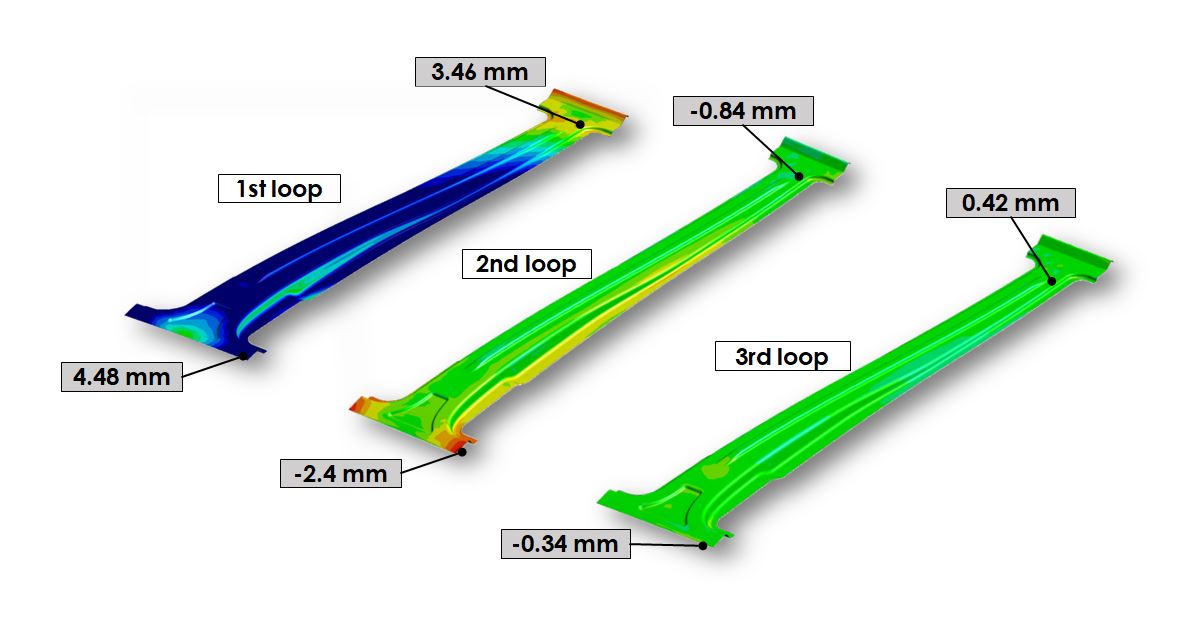
Inside of Stampack forming simulation software, the springback of parts can be accurately simulated and the form tooling used can be automatically compensated to correct for the springback. Especially for complex, non-linear bends, the springback calculation benefits from the high-quality incremental forming simulation in Stampack is essential for tool designers. This delivers much better results than values based on table lookups within different die design books or compared with the approximations given by any “one-step” solvers which do not simulate incrementally.
Stampack calculates springback after both shell and solid simulations. However, the high resolution of the forming process in solid simulations leads to an even more accurate springback result. Springback compensation compares the simulated part against the CAD geometry in order to measure how far the simulated part deviates from the target. The form tooling used is then compensated automatically in the reverse direction based on an intelligent optimization algorithm.
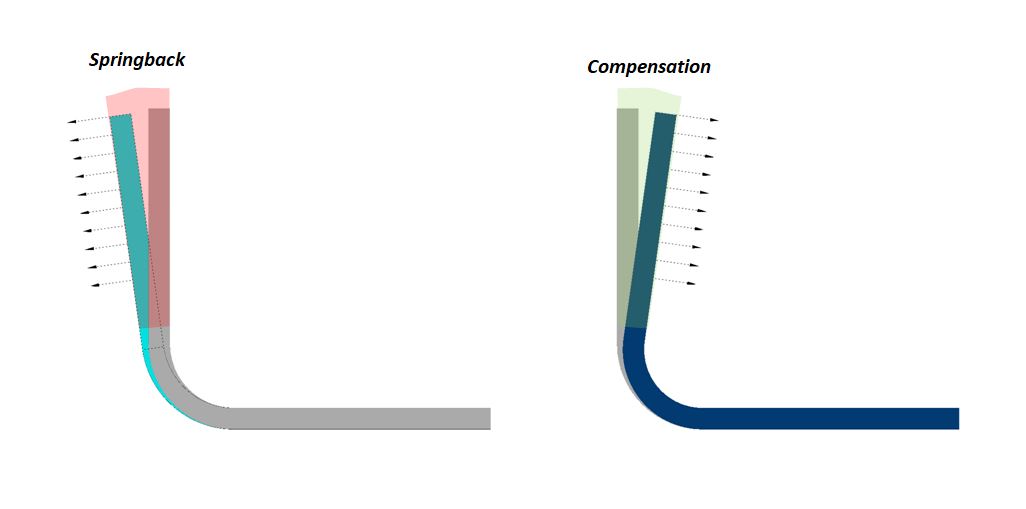
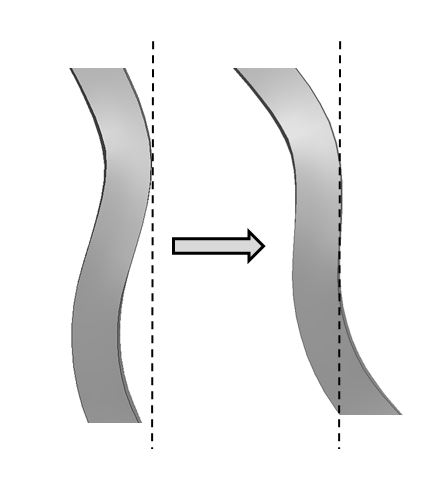
One of the highlights of Stampack’s compensation algorithm is the automated detection and removal of undercuts when the compensated tooling tries to compensate past any vertical walls. Stampack will retain these vertical walls and not compensate further in order to still have tooling that can form the part and close in the die.
Typically, springback compensation is an iterative procedure. All the iterations are simulated in Stampack and the algorithm shows an excellent convergence behavior.